
St Martin'sCE Primary School
Home Learning
Home Learning at St Martin’s
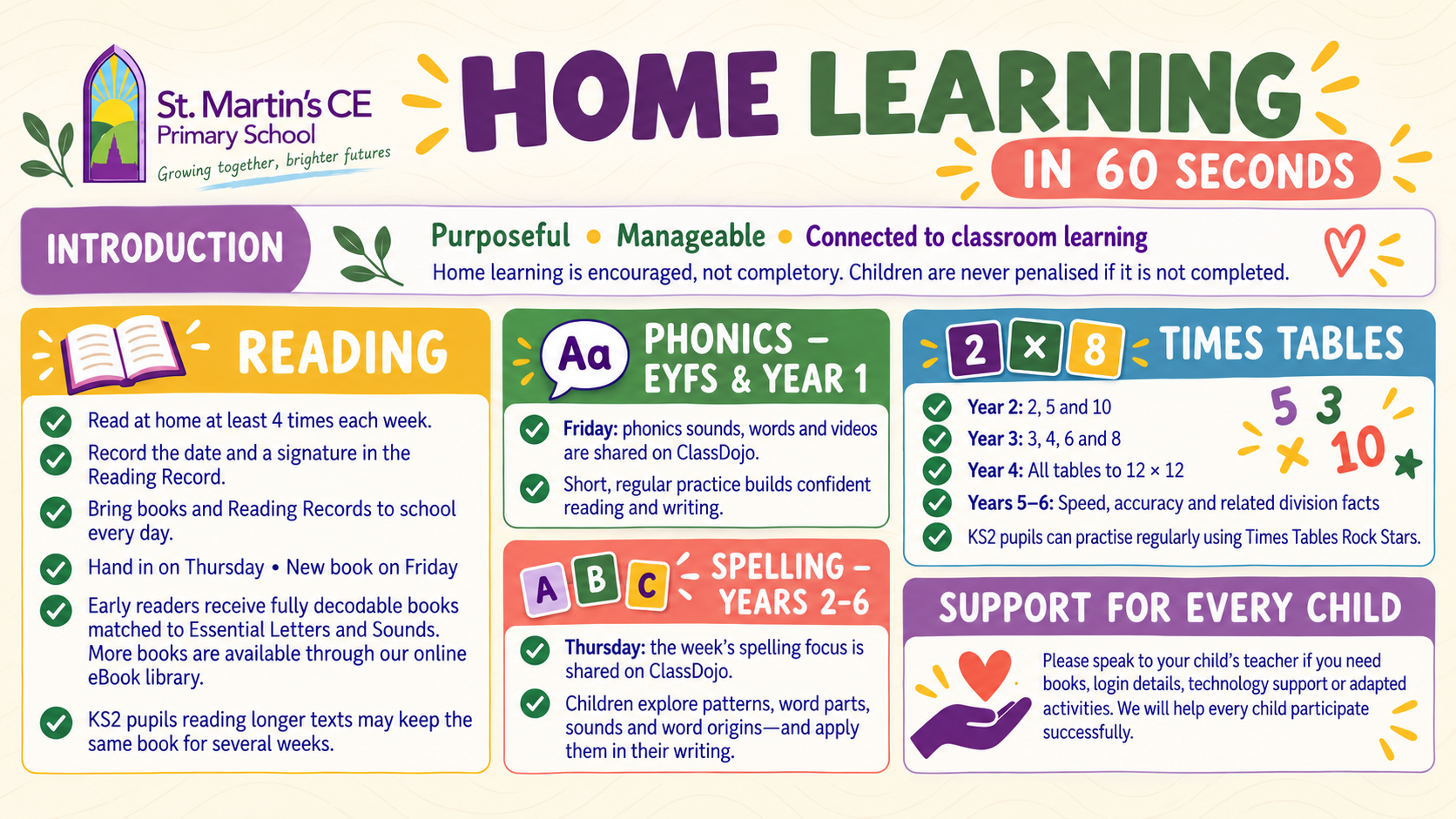
We believe that home learning should be purposeful, manageable and closely connected to what children are learning in school. Evidence suggests that homework in primary schools is most effective when it is carefully chosen, clearly explained and provides opportunities to practise and secure important knowledge.
Our home learning focusses on the core skills that benefit most from regular practice:
-
Reading and phonics
-
Spelling and word knowledge
-
Number facts and times tables
Home learning is not compulsory, and children will not be penalised if it is not completed. However, we strongly encourage every child to participate because regular practice helps to build confidence, independence and positive learning habits. This becomes particularly important in Years 5 and 6 as children prepare for secondary school.
We recognise that families have different circumstances. If your child is experiencing any barriers to completing home learning, including difficulty accessing books, technology or online platforms, please speak to their class teacher. We will work with you to provide appropriate resources and support. Activities may also be adapted where needed so that pupils with SEND or those learning English as an additional language can participate successfully.
Reading
Reading is at the heart of our curriculum. Regular reading at home helps children become fluent, confident readers and supports their learning across every subject.
Children across the school are provided with a reading book carefully matched to their current stage of reading development. Early readers receive fully decodable books aligned with our Essential Letters and Sounds phonics programme. These contain only the sounds and words children have already been taught, enabling them to practise successfully and build fluency. Families can also access additional books at the appropriate level through our online eBook library.
Reading for Pleasure
Children may also take home a book from the school or class library. This is a reading-for-pleasure book and may be more challenging than their reading-scheme book. We encourage families to enjoy these books together by reading aloud, talking about the story and exploring unfamiliar words.
Library books may usually be kept for longer because they are often longer texts. Children should also be encouraged to enjoy picture books, poetry, magazines, comics and audiobooks.
Reading Expectations
We ask children to read at home on at least four occasions each week. Each reading session should be recorded in the child’s Reading Record by adding the date and a parent or carer’s signature. Comments are welcome but are not required.
Even when children are fluent and confident readers, we encourage parents and carers to listen to them read and talk to them about their books regularly.
Reading Records and reading books should be:
-
Brought to school every day.
-
Handed to the class teacher each Thursday.
-
Returned to children, with their new book, each Friday.
Bringing reading books to school every day allows children to read regularly with an adult.
Children in Key Stage 2 who are reading longer texts may keep the same book for several weeks, allowing them sufficient time to read and enjoy it fully. They should still bring their book in every day and return their book and Reading Record each Thursday so that teachers can monitor their reading and check whether a new book is needed.
Phonics
Each Friday, teachers in EYFS and Year 1 share the phonics learning that children have been practising that week through ClassDojo. This may include sounds, words or a short pronunciation video.
Short, regular practice at home helps children remember new sounds and apply them confidently when reading and writing.
Spelling and Word Knowledge
From Years 2 to 6, spelling is taught through Essential Spelling and Word Knowledge, which builds on our phonics programme.
Rather than memorising a fixed weekly list for a test, children learn how words work. They explore:
-
Spelling patterns and phonological rules
-
Morphemes and how words are constructed
-
Word origins and etymology
-
How spelling knowledge is applied in sentences and independent writing
Children’s understanding is checked through activities including games, sentence dictation and their everyday writing.
Each Thursday, teachers share the week’s spelling focus through ClassDojo so that families can revisit and practise it at home.
Times Tables
Secure knowledge of multiplication tables and the related division facts helps children approach more complex mathematics confidently and accurately.
Our expectations are:
-
Year 2: 2, 5 and 10 times tables
-
Year 3: 3, 4, 6 and 8 times tables
-
Year 4: All multiplication tables up to 12 × 12
-
Years 5 and 6: Increasing speed, accuracy and recall of related multiplication and division facts
Times Tables Rock Stars
All children in Key Stage 2 have access to Times Tables Rock Stars. This online resource provides regular, engaging practice to help children develop rapid and accurate recall of multiplication and division facts.
Children are given an individual login and are encouraged to use Times Tables Rock Stars regularly at home. Please contact your child’s teacher if you need the login details or support accessing the platform.